dALI 24
Research-scale automation for adherent SBS plate workflows. dALI 24 combines incubation, live-cell imaging, and liquid handling to monitor conditions and execute threshold-triggered interventions with protocol-linked logging.
A workflow cell for microplate culture
dALI 24 is designed around adherent culture in SBS plates. Plates are housed under controlled temperature and gas conditions, imaged on a defined schedule, and serviced by liquid handling for routine media operations and protocol steps. Imaging and telemetry provide context for QC, then trigger rule-defined actions when thresholds are met.
- 24-plate incubator for parallel cultures and time-staggered workflows
- Condition-triggered actions using imaging metrics (for example, confluency thresholds) and telemetry
- Protocol-linked record of actions, images, and measurements (CCA Labs connection optional)
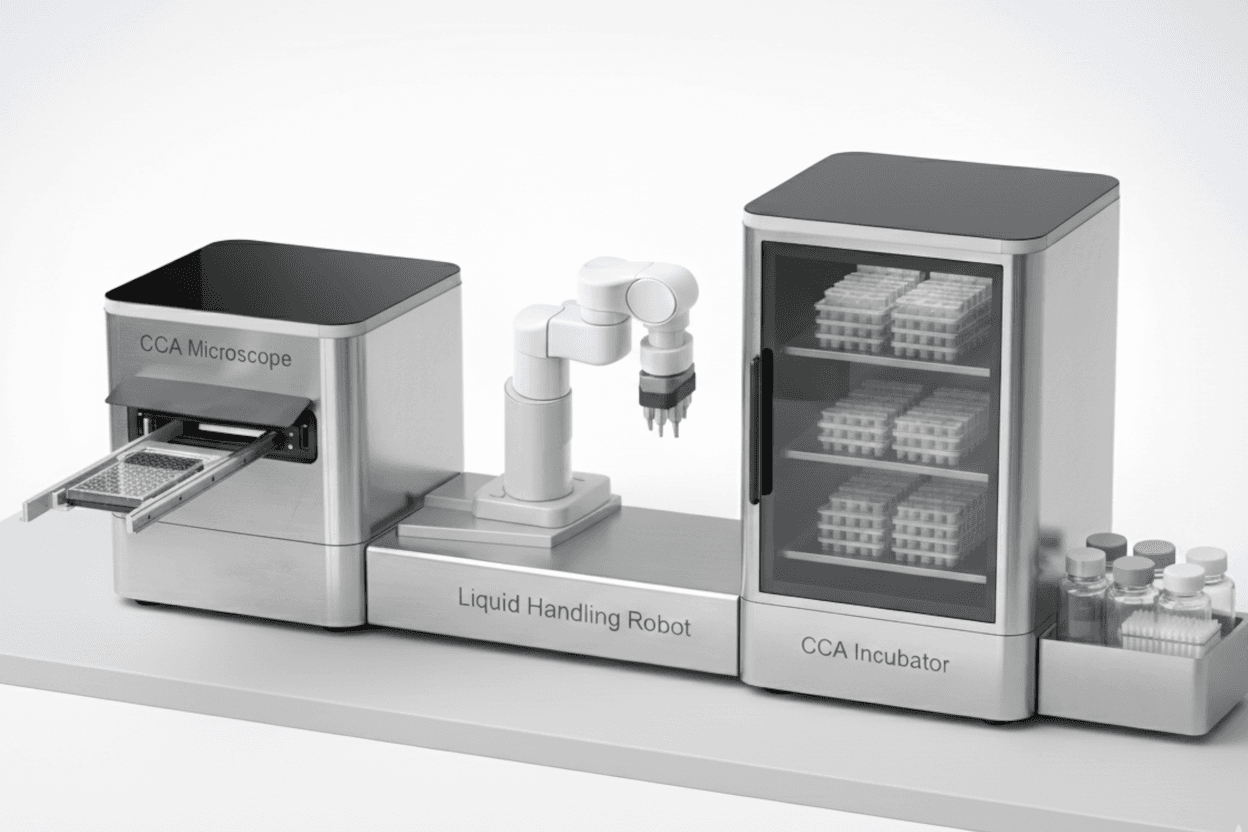
Imaging, incubation, liquid handling, telemetry
Modules are designed to operate as a single system. You define a protocol, schedule, and thresholds. The system executes steps and logs the time-aligned context needed to interpret outcomes and deviations.
CCA Microscope
Time-series imaging
CCA Incubator
24 plates, tri-gas
Liquid Handling
Media operations
Pebble Batch-Risk Monitoring
Context logging
Imaging readouts (examples)
- Confluency trajectory by acquisition timepoint
- Morphology change flags (protocol-defined)
- Growth curves and threshold-crossing timestamps
- Real-time monitoring and alerts for interventions when required (e.g., feed, passage)
Environmental context
- Temperature, humidity, CO₂, O₂ time series
- Excursion events and recovery dynamics
- Media-color checks as a proxy for pH drift (workflow-dependent)
- Time alignment to imaging and protocol steps
- Optional linkage to experiment records in CCA Labs
What it can run
Media operations
Passaging (adherent)
Long protocols
Note: dALI 24 focuses on adherent plate workflows. Suspension cultures are out of scope for this system at the moment.
Integrated cell workflows at 24-plate scale
dALI 24 runs adherent SBS plate workflows across incubation, imaging, and liquid handling. You define a schedule and decision rules (for example, confluency thresholds or timed media changes). The system executes steps, captures time-aligned imaging and environment context, and produces a protocol-linked record suitable for comparison across runs and teams.
iPSC and stem cell workflows
maintenance • expansion • differentiationMaintenance and expansion
Schedule media feeds or reagent additions over days to weeks with consistent imaging timepoints. Include colony-selection checkpoints and capture consistent timepoints across plates for run-to-run comparison.
Passaging as a defined protocol
Execute aspirate → wash → dissociate → re-plate steps with programmed timings and volumes. Use pre/post imaging checkpoints to confirm expected state transitions.
Differentiation schedules
Run long, multi-day media programs with fixed timepoints and defined checkpoints. Imaging provides a continuous record of morphology changes for review and analysis.
Organoids and 3D models
longitudinal culture • growth trackingLong-horizon maintenance
Run repeatable media schedules over days to weeks with consistent imaging timepoints. Track growth and structural change over time across many conditions.
Conditioned environments
Apply controlled O₂/CO₂/temperature profiles and align these profiles to imaging and protocol steps. Useful for microenvironment-dependent phenotypes.
Reproducible scale-out
Scale a protocol across plates to compare matrices of factors (media, coatings, growth factors, oxygen setpoints) without manual timing drift.
Dynamic control experiments
O₂ shifts • stress profiles • time-varying conditionsHypoxia and reoxygenation
Run defined O₂ transitions and observe response trajectories with time-aligned imaging. Supports normoxia ↔ hypoxia comparisons without manual handling.
Timed perturbations
Add compounds or factors at exact timepoints, then track kinetics in the same plate over time. Useful when timing and dose history matter.
Structured datasets
Imaging + environment + action logs form a single dataset per run. This reduces ambiguity when interpreting phenotype changes.
Workflows that scale across the dALI family
same protocol model • more throughputDefine once
Protocols are expressed as schedules + decision rules (state → action). The same definition can be reused across plates, users, and sites.
Run at 24-plate scale
Execute consistent operations across many cultures in parallel. This is designed for optimisation and comparability, not one-off artisanal timing.
Extend to larger systems
The goal is a common workflow and data model across the dALI family. That enables scale-up without rewriting protocols or losing traceability.
Early access
We are collecting workflows from early users to prioritise the first set of automated protocols. If you run adherent cultures in SBS plates and want threshold-based automation, contact us.
Looking for manufacturing scale? Explore dALI 500 →